


Focusing on key industrial chains such as photovoltaic modules, the Ministry of Industry and Information Technology has launched the 2026 Industrial Energy Conservation Inspection
Source:Ministry of Industry and Information Technology:2026-05-15 14:06:02
Industry Trends
On May 13, the General Office of the Ministry of Industry and Information Technology issued a notice on organizing the 2026 industrial energy conservation supervision work. The notice stipulates that in accordance with mandatory industry energy consumption limit standards and mandatory product and equipment energy efficiency standards, special energy conservation inspections will be conducted on key enterprises in critical industrial chains such as photovoltaic modules, wind turbines, power and energy storage batteries, and hydrogen production equipment via water electrolysis. The focus will be on examining energy consumption during production processes and the energy efficiency of major products.
The original text is as follows:
Notice of the General Office of the Ministry of Industry and Information Technology on Organizing and Carrying out the 2026 Industrial Energy Conservation Supervision Work
Department of Industry and Information Technology Jiehan [2026] No. 221
The competent departments of industry and information technology in each province, autonomous region, municipality directly under the central government, and Xinjiang Production and Construction Corps:
In accordance with the relevant provisions of the Energy Conservation Law of the People's Republic of China and the Measures for Industrial Energy Conservation Supervision (Order No. 58 of the Ministry of Industry and Information Technology), in order to strengthen the supervision of the entire process of energy conservation and carbon reduction, vigorously promote industrial energy conservation and carbon reduction, actively and steadily promote and achieve carbon peak, we are now organizing the 2026 industrial energy conservation supervision work. The relevant matters are notified as follows:
1、 Work tasks
(1) Energy efficiency supervision in key industry sectors. According to the mandatory energy consumption limit standards and energy efficiency benchmark levels in relevant industries, energy-saving supervision will be carried out on enterprises in industries such as steel, synthetic ammonia, refining, ethylene, caustic soda, soda ash, methanol, polyvinyl chloride, electrolytic aluminum, industrial silicon, cement, flat glass, building and sanitary ceramics, and computing facilities. In principle, energy-saving supervision will be fully covered for the above-mentioned industries in the local area from 2026 to 2027 (full coverage should be achieved for calcium carbide polyvinyl chloride production enterprises by 2026).
(2) Energy efficiency supervision of key industrial chains. According to the mandatory energy consumption limit standards and mandatory energy efficiency standards for products and equipment in relevant industries, we will focus on key industrial chains such as photovoltaic modules, wind turbines, power and energy storage batteries, and water electrolysis hydrogen production equipment. We will carry out special energy-saving supervision on key enterprises in raw materials, production and manufacturing, terminal assembly, and other links, with a focus on verifying the energy consumption of the production process and the energy efficiency of the main products of the enterprises.
(3) Energy efficiency monitoring of key energy consuming equipment. According to the mandatory energy efficiency standards for product equipment, as well as the requirements for advanced energy efficiency levels, energy-saving levels, and admission levels, energy-saving inspections will be carried out on energy consuming equipment such as motors, transformers, fans, pumps, air compressors, and industrial boilers that are included in key industry sectors and key industrial chains. Relevant departments will supervise enterprises to eliminate inefficient equipment that does not meet the mandatory energy efficiency standards in accordance with the law.
(4) Review and supervise the implementation of rectification measures for non compliant enterprises in 2025. Conduct a 'look back' on the illegal and irregular enterprises discovered in the 2025 industrial energy conservation supervision. Those who fail to rectify as required or fail to rectify in place shall be dealt with in accordance with the law and regulations.
2、 Job requirements
(1) Strictly regulate law enforcement. Implement the Opinions of the General Office of the State Council on Strictly Regulating Administrative Inspections of Enterprises (State Council Document [2024] No. 54), further standardize the procedures and measures for industrial energy conservation supervision, and effectively reduce the burden on enterprises. Strengthen coordination and cooperation with relevant departments in the local area, improve the inter departmental linkage mechanism for industrial energy conservation supervision, and promote the establishment of a joint disciplinary mechanism. Timely disclose the industrial energy conservation supervision situation to the society, publish the list of non compliant enterprises in accordance with the law, and actively accept social supervision.
(2) Strengthen capacity building. Make good use of the online platform of "National Industrial Energy Conservation Supervision Training", organize local industrial energy conservation supervision personnel to participate in training, and continuously improve the professional ability level of law enforcement personnel. Promote technological means such as digital energy and carbon management centers for industrial enterprises and online reporting of industrial energy conservation monitoring results to ensure accurate and efficient industrial energy conservation monitoring. Encourage the adoption of joint law enforcement by provinces, cities, and counties, as well as the introduction of third-party professional institutions to support and assist, in order to enhance the efficiency of industrial energy conservation supervision.
(3) Strengthen the application of results. For enterprises found to have unreasonable energy use behavior and weak energy management foundation in industrial energy-saving supervision, urge them to accelerate the implementation of energy-saving and carbon reduction transformation. Explore the application of industrial energy conservation monitoring results to the accounting and management of enterprise carbon emissions, product carbon footprint, and promote data sharing. We will coordinate the promotion of industrial energy conservation supervision and diagnostic services for industrial energy conservation and carbon reduction, as well as the energy-saving and carbon reduction transformation of key industries, to form a joint force for industrial energy conservation and carbon reduction.
(4) Carry out daily energy-saving supervision. Strengthen daily energy-saving supervision work, mainly including: the implementation of mandatory energy consumption limit standards and mandatory energy efficiency standards for products and equipment in industries not covered by national special industrial energy-saving supervision; The implementation of energy management systems for key energy consuming enterprises, the establishment of energy management positions, and the performance of energy management leaders, as well as the implementation of energy measurement, energy consumption statistics, and energy utilization reporting systems, and the implementation of energy-saving education and training. Encourage conducting research on industries that have not yet been included in the scope of supervision but have experienced rapid growth in energy consumption and carbon emissions, in order to solidify the data foundation for the implementation of the dual control system for carbon emissions. Daily energy-saving supervision should promptly announce the results, track and supervise the implementation of rectification.
3、 Work arrangement
(1) The Ministry of Industry and Information Technology will organize relevant institutions in a timely manner to conduct special research on the implementation of industrial energy conservation supervision work in various regions, as well as the establishment of institutions, responsibilities, and capacity building, to listen to opinions and suggestions on further improving the efficiency of energy conservation and carbon reduction supervision, and promote the strengthening of industrial energy conservation and carbon reduction management and supervision law enforcement capacity building in various regions. Report on the progress of industrial energy conservation supervision and special research as appropriate.
(2) Provincial industrial and information technology departments should formulate supervision plans based on actual conditions, clarify task lists, refine work measures, and strive to achieve practical results. Please submit the 2026 industrial energy conservation supervision tasks to the Ministry of Industry and Information Technology (Department of Energy Conservation and Comprehensive Utilization) before May 29, 2026, and submit the annual summary report and detailed data of industrial energy conservation supervision before November 15, 2026 (both the electronic version of the supervision tasks and summary report are submitted synchronously through the industrial energy conservation and green development management platform green-miit.gov.cn).
3、 Contact Information
Contact person and phone number: Zhang Kun 010-68205361/5337 (fax)
E-mail jienengchu@miit.gov.cn
Summary Table of Industrial Energy Conservation Supervision Tasks for 2026
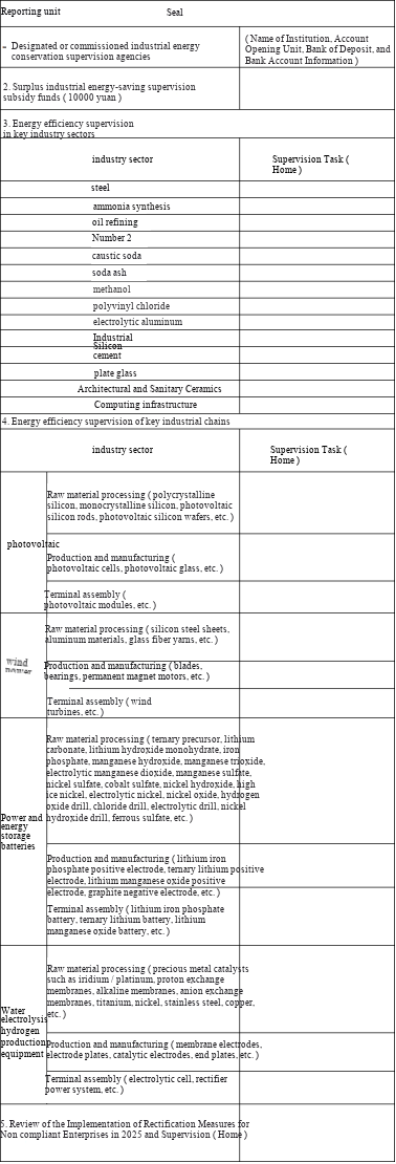
Note: 1. For enterprises involved in multiple links of the industrial chain in the "energy efficiency supervision of key industrial chains", the number of statistical supervision tasks should be counted based on the most terminal link of the industrial chain they are in.
2. Each enterprise is only allowed to select one national special industrial energy conservation supervision task from the options of "Energy Efficiency Supervision in Key Industries", "Energy Efficiency Supervision in Key Industrial Chains", and "Review Supervision on the Implementation of Rectifications for Violating Enterprises in 2025". It is not allowed to carry out two or more special industrial energy conservation supervision tasks for the same enterprise. In principle, "Energy Efficiency Supervision of Key Energy-Consuming Equipment" should not be declared separately.
3. In the "Energy Efficiency Monitoring of Key Industries" and "Energy Efficiency Monitoring of Key Industrial Chains", if the same enterprise produces multiple products, it should be declared as one enterprise, and indicated in Annex 2.
4. Conduct "energy efficiency supervision of key energy-using equipment" for all enterprises involved in "energy efficiency supervision of key industry sectors" and "energy efficiency supervision of key industry chains".
Attachment 2: List of Industrial Energy-Saving Monitoring Enterprises for 2026
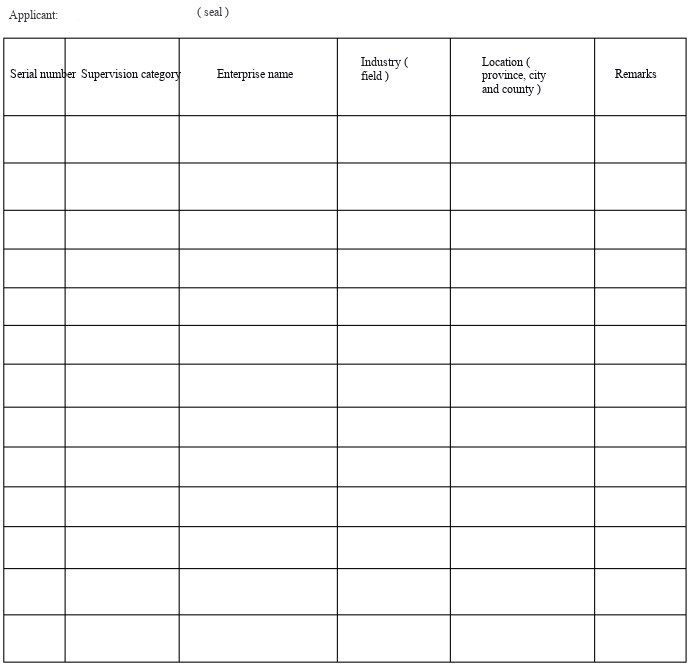
Note: 1. The types of supervision include: energy efficiency supervision in key industries and fields, energy efficiency supervision in key industrial chains, and "look-back" supervision on the rectification and implementation of non-compliant enterprises in 2025.
2. In the energy efficiency supervision of key industries and key industrial chains, the applicable industry energy consumption limits, energy efficiency rating standards, or energy efficiency benchmark levels and baseline levels should be indicated in the remarks.
3. In the energy efficiency monitoring of key industries and key industrial chains, if the same enterprise produces multiple products, it should be declared as one enterprise, and the product types should be indicated in the "Industry (Field)" column.
4. The production process of PVC manufacturing enterprises, including calcium carbide method, ethylene method, etc., should be indicated in the "industry (field)".
Original title: Notice of the General Office of the Ministry of Industry and Information Technology on Organizing the Implementation of the 2026 Industrial Energy Conservation Supervision Work